
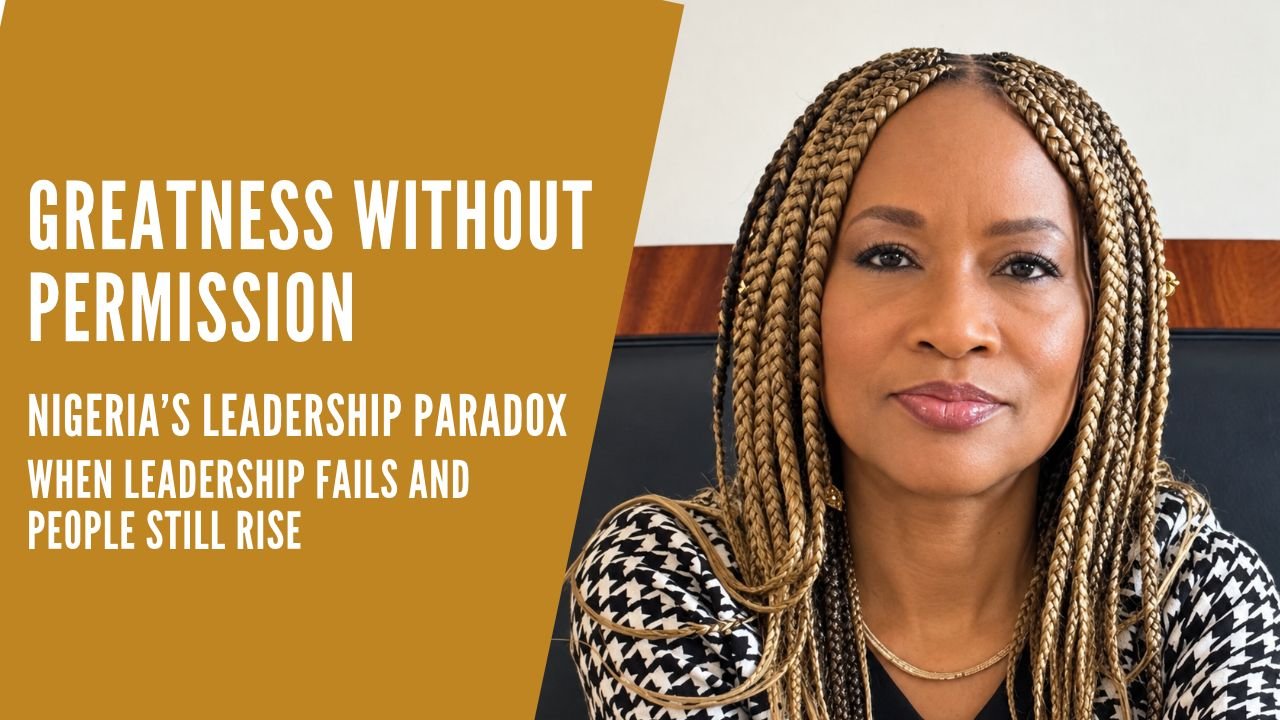
Greatness Without Permission: Nigeria’s Leadership Paradox – When Leadership Fails and People Still Rise
By Mary Eniolu | 02 October 2026
As the UK begins its Black History Month celebrations and Nigeria marks 66 years of independence, I find myself reflecting on the great nation of my birth. A country overflowing with brilliance, weighed down by broken systems, yet still rising in ways the world cannot ignore.
Nigeria’s Interesting Paradox.
Nigeria is, in many ways, a paradox. For decades, the country has faced significant challenges around leadership, governance, infrastructure and economic development. Institutions have faltered, systems have weakened, and national progress has often felt painfully slow. And yet, Nigerians continue to make their mark globally in music, medicine, film, technology, sport, literature, business and beyond. When I think about Nigeria, three words come to mind: Potential. Frustration. Hope.
POTENTIAL
Nigeria has an abundance of it. It is a resource-rich nation with an enormous and enterprising population. Its greatest resource, however, may not be beneath the ground at all, but its people.
A large, hardworking, intelligent, talented, creative, driven, resilient, ambitious and entrepreneurial population. Nigerians are problem-solvers by instinct and innovators by necessity. From fashion and music to technology, medicine, sport and business, Nigerians consistently demonstrate a level of ingenuity that makes the country one of the most powerful human‑capital engines in the world.
Then there is the land. Nigeria has vast agricultural potential, with diverse ecological zones that support the cultivation of crops ranging from cassava, yam and maize to cocoa, oil palm, grains and legumes.
Its natural resource base is equally significant, encompassing oil and gas alongside extensive deposits of minerals including gold, iron ore, tin, lead, zinc, limestone and lithium….and this is just scratching the surface. So when I say potential, I mean enormous potential. But potential remains only potential until it is converted into progress, and that’s where my next word comes in.
FRUSTRATION
Potential unrealised will only lead to frustration. How can a country with such extraordinary human and natural resources have so many of its people struggling simply to get by? The World Bank estimates that in 2025, 50.8% of Nigerians, approximately 123 million people were living in extreme poverty, using its $3-a-day international poverty line. At the higher lower-middle-income poverty line of $4.20 a day, the figure was 69.6%.
Behind those percentages are human beings. Families making impossible choices. Young people with talent and ambition but with limited opportunities. Entrepreneurs trying to build businesses while navigating an environment that can make the simplest things unnecessarily difficult.
This is the heartbreak of Nigeria: a nation overflowing with wealth, talent and opportunity, but constrained by systems that do not work as they should. Infrastructure gaps, inconsistent policies, corruption, insecurity, and decades of governance failures have created a reality where people must fight twice as hard to achieve half as much.
This is the frustration. The frustration of knowing what could be, while living with what is. The frustration of watching brilliance suffocate under bureaucracy. The frustration of seeing potential trapped behind poor leadership. And yet, my third word remains in the mix.
HOPE
There remains hope because despite the challenges, Nigerians keep rising. Not waiting for perfect conditions. Not waiting for everything to be fixed. Not waiting for permission. They are creating, innovating, building and succeeding anyway. Let’s look at what Nigerians are achieving across the world.
1. Medicine and Healthcare
Nigeria continues to produce medical professionals, researchers and innovators making significant contributions both at home and internationally. In 2024, Nigeria became the first country in the world to introduce the WHO-recommended Men5CV five-in-one meningitis vaccine, a significant public-health milestone. Only recently in September 2026, Nigeria completed its first-ever tele-robotic surgery, and a historic first for West Africa, with a surgeon controlling a robotic console in Ogun State to operate on a patient 500 kilometres away in Abuja. These achievements matter because they challenge the narrative that innovation is something that happens elsewhere.
Nigerian medical professionals continually drive advancements in public health, cardiology, and oncology worldwide, with practitioners like Surgeon-in-Chief Dr. Oluyinka Olutoye, Dr. Abdullah Shehu, Dr. Sylvia Kama-Kieghe, and Dr. Isioma Okobah actively shaping global medical standards and emergency healthcare response internationally.
2. Music and Entertainment
Few things demonstrate Nigeria’s global cultural influence more visibly than Afrobeats. Burna Boy, Wizkid, Tems, Davido, Rema and a host of other Nigerian artists have taken Nigerian music from local and continental success to global phenomenon.
Wizkid’s Essence, featuring Tems, became the first Nigerian song to reach the Top 10 of the Billboard Hot 100. Burna Boy became the first Nigerian male artist to win a Grammy for an original work, and Tems won the Grammy for Best African Music Performance in 2025. Afrobeats is no longer simply Nigerian music enjoyed by Nigerians, but is literally played everywhere from your local Super Drug store to super bowl arenas.
3. Film and the Creative Industries
Nollywood is one of the world’s largest film industries by output, with filmmakers and actors such as Genevieve Nnaji, Kunle Afolayan and Funke Akindele gaining international recognition, and Nigerian films winning at Cannes Lions and Venice Film Festival.
4. Technology and Fintech
Nigeria has also emerged as one of Africa’s major technology and fintech hubs. Companies such as Paystack, Flutterwave, Moniepoint and Moove have built businesses around solving real problems financial access, mobility and the infrastructure required for a digital economy. Paystack’s acquisition by Stripe was a significant moment, not simply for the company but as a signal of the value and global relevance of Nigerian-built technology. This is what innovation looks like when people see a problem and decide not merely to complain about it, but to solve it.
5. Sports
How can we not talk about sports. From athletics and football to basketball, combat sports and motorsport, Nigerians and people of Nigerian heritage continue to make their mark internationally. Tobi Amusan has become a globally recognised athletics star. Israel Adesanya and Kamaru Usman have established themselves among the most prominent names in mixed martial arts. In basketball, players of Nigerian heritage, including Nneka Ogwumike and others across the NBA and WNBA, have achieved at the highest levels. Different sports. Different countries. Different journeys. But a familiar thread: Nigerian talent showing up on the world stage.
6. Literature and Academia
We cannot talk about Nigerian excellence without talking about ideas. Nigerians such as Wole Soyinka, the first African Nobel Laureate in Literature, Chimamanda Ngozi Adichie, Ngozi Okonjo-Iweala and Akinwumi Adesina have achieved significant global influence in literature, economics and international leadership. Chinua Achebe’s Things Fall Apart has sold millions of copies and been translated into more than 50 languages. Contemporary Nigerian writers regularly win or shortlist for international honors like the Booker Prize and the Women’s Prize for Fiction with Authors like Chimamanda Ngozi Adichie, one of the world’s most internationally recognised contemporary writers and Buchi Emecheta (bless her soul) paving the way for a new wave of globally celebrated writers. Again and again, Nigerians are demonstrating what is possible.
So what does all this tell us about people and leadership?
Perhaps it tells us that when people lead from where they are, people are capable of achieving greatness even when the leadership around them is less than great. Perhaps it tells us that people can thrive despite the system. Does that mean leadership doesn’t matter? Absolutely not. I am a firm believer in John Maxwell’s maxim: “Everything rises and falls on leadership.”
I believe leadership matters enormously, in family, business, an organisation, a community or a nation. Leadership shapes culture. Leadership shapes opportunity. Leadership determines what gets encouraged, what gets tolerated and what gets developed. Good leadership can create an environment in which people flourish. Poor leadership can make flourishing unnecessarily difficult. But there is a different type of leadership that I think we sometimes overlook, what I call “People Leadership”.
PEOPLE LEADERSHIP
People leadership is the kind of leadership that does not depend on title, position, or hierarchy. The leadership that happens when ordinary people decide to take responsibility for the influence they have, right where they are. It is leadership expressed through initiative, responsibility, courage, creativity, and ownership.
Think about your organisation. What would happen if everyone led from where they are? If people didn’t wait for permission to solve problems? If teams didn’t wait for senior leaders to set the tone? If individuals took responsibility for culture, excellence, and standards? If the receptionist took ownership of the experience every customer received? If the team member who noticed a problem didn’t simply say, “That’s not my job,” but asked, “What can I do about it?” If leadership became a behaviour rather than a job description? Organisations transform when leadership becomes distributed, when people lead because they choose to, not because they are told to. Nigeria is proof of this.
This is the Nigerian Leadership Paradox. For all the frustration, Nigerians have continued to demonstrate a remarkable capacity to lead themselves, and to create opportunities where there were few, to build businesses in difficult environments, to make their mark around the world, to create technology that solves global problems and to achieve at the highest levels internationally, not because of the leadership, but in spite of it.
GREATNESS WITHOUT PERMISSION
There was a time when Nigerians hesitated to admit their nationality. Not anymore. Today, Nigerians proudly claim their heritage, and increasingly, non‑Nigerians claim it too! The music. The fashion. The language. The culture. The creativity. The Cuisine.… even King Charles admits Nigeria’s jollof rice is the best.
Nigeria’s story is one of great potential and great frustration, but it also a story of hope. It is a story of resilience, ingenuity, tenacity, and rising against all odds. As King Charles himself said: “Niger no dey carry last.”
FINAL THOUGHT
Perhaps then the challenge for us all is this: wherever you are, whatever your position, whatever your circumstances, lead from there. You may not have permission to change the whole system. But you do have influence over your corner of it. People can rise despite poor leadership, but imagine what becomes possible when good leadership creates an environment where people don’t have to rise despite it, but rise because of it. That is the Nigeria I live in hope to see. A Nigeria where the extraordinary potential of its people is matched by the quality of the leadership serving them. Until then, I say: More power to the people…..Lead on.
© October 2026
I hope you have found this article helpful. Please feel free to leave your comments. I would very much love to hear from you.
________________________________________
About The Author
Mary Eniolu is a published author, professional speaker, leadership coach and culture architect. She is founder of Can Do Academy, a learning and development company empowering individuals, teams and organisations to close the gap between performance and potential, utilising bespoke CPD accredited training and coaching solutions. Whether working with an individual, an SME or fortune 100 company, Mary’s goal remains to enhance performance, achieve better results and enrich lives.
Check out our FREE RESOURCES HERE


About Post Author